
How to Teach Paragraph Writing to Grade 2 or Grade 3
How to teach paragraph writing to grade 2 and grade 3 students? Project a writing sample on your smartboard to visually show that a paragraph is a group of sentences based on one idea.
Prewriting graphic organizers are a great way for students to organize their ideas for paragraph writing. These graphic organizers are visually appealing as they consist of real pictures and include a word bank that helps includes teacher notes for each component.

Also included in this bundle are fact and opinion task cards, writing graphic organizers and sentence strips for students to sort, cut and paste! Perfect for writing lessons, reading and writing centers, early finisher activities and sub plans!


How to Teach Paragraph Writing to Grade 2 or Grade 3

This bundle consists of:
How to Write Paragraphs Packet-
1. For the teacher:
- 8 step-by-step mini-lessons
- How to Use this Resource (teacher notes)

2. 12 Real-life Photo Task Cards with step-by-step directions on the back:
This is a great pre-writing activity for students to work either independently, in pairs or small groups to build rich oral language prior to using the writing templates.

3. 10 Paragraph Writing Prompts with Real-life Photos + Vocabulary Word Bank (templates prints well in both color or b/w. If you prefer, project the color version on your smartboard and print students the b/w writing templates:
- Sea Life Scene
- Cooking Scene
- Penguins & Antarctica Scene
- Building Sandcastles Scene
- Flying Kites Scene
- Hiking in Fall Scene
- Washing Pet Dog Scene
- Picking Wildflowers Scene
- Elephants (mother and calf)
- Diwali Celebration Scene
- Building a House Scene
4. Making Inferences Graphic Organizers with photos: Students study the photo, draw arrows coming out from the photo and infer what they think is happening?
- Kids on a kayak
- An artist painting on a canvas
- A family of baboons
- Children racing at a carnival
- A game of hide and seek
- People cycling through city
- Pumpkin picking
- Green frogs on a branch
- Vet with sick kitten
- Girl feeding ducks at a pond
This differentiated resource includes the following:
- How to Use this Resource
- Lesson Ideas
- 10 Picture Writing Prompts
- Extra-line Writing Templates for differentiation purposes
- 10 Picture Prompt Task Cards with guided questions printed on the back
- 10 Picture Prompt Graphic Organizers

This comprehensive picture prompt resource covers the following skills:
- Critical Thinking Skills: Encourage students to analyze the picture and make predictions. Draw conclusions based on the visual cues. For example, if the picture shows a child holding an umbrella and dark clouds in the background, the child might infer that it is going to rain soon.
- Narrative Skills: Prompt students to use the task cards to create a story based on the picture. This helps develop their imagination and narrative skills as they describe the characters, setting and events depicted in the image.
- Persuasive Skills: Students use task cards to orally express their opinion to convince others of their beliefs/ideas
- Paragraph Writing: Differentiated writing templates to help students organize their thoughts and ideas in sequential paragraphs
- Problem-Solving Skills: Present a picture with a problem or challenge and ask the child to come up with possible solutions. This fosters their ability to think critically and find creative ways to solve problems.
- Empathy and Emotional Intelligence: Use pictures that depict different emotions on characters’ faces and encourage the child to infer the emotions being expressed. This helps them develop empathy and understand different emotional states.
- Observation Skills: Ask students to observe the picture carefully and identify different objects, colors, shapes, or patterns within the image.
- Sequencing Skills: Provide a series of pictures and ask students if they can place in categories (e.g. seasons, events, holidays, habitats etc)
- Visualizing Skills: Ask students to describe what might be happening ‘beyond the photo.’ This helps develop the skill of visualizing, imagining and inferring.
- Comparing and Contrasting Skills: Provide two different pictures and ask the child to compare and contrast the elements, identifying similarities and differences between the two.
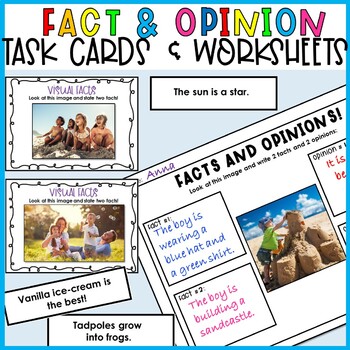
Ideal to project on smartboard for whole class instruction and then print:
- Teacher Notes/Suggestions on how to use resource
- 20 Task Cards with real photos
- 16 Fact and Opinion Graphic Organizers
- 16 Sentence Strips
- Sorting Sentence Strip Graphic Organizers
Join my email list to receive exclusive FREE resources and content!

Let’s connect!
Integrate teaching informational writing with fun Animal Research Projects! Click here.


No Comments